

















 THE SKY IN MARCH
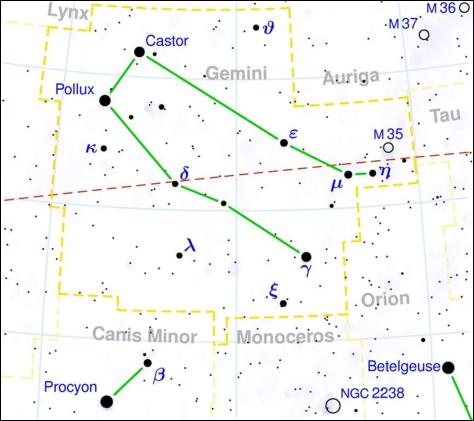
I have chosen Gemini (the Twins) as this month’s constellation. It is in the south-
southwestern sky about midnight, above and to the left of Orion. Two fairly bright stars at the
top left are named Castor and Pollux and form the heads of the twins. With a bit of
imagination you can see two “stick men” that form the constellation itself as shown in this
diagram:
Just above the left foot of the twin Castor is an open cluster of stars known as M35 which is
visible to the naked eye but better seen with a small telescope or binoculars. This cluster is
made up of several hundred stars and covers an area of sky about the same size as the full
moon (about half a degree).
PLANETS
Mercury on 5th of this month is at its furthest east from the Sun which means it sets quite a
long time (by Mercury’s standards) after sunset making it relatively easy to find but not very
exciting to view as it is small and featureless unless you have use of a large telescope. It just
looks like a very mini-Moon.
Venus has been very conspicuous in the western sky for the last couple of months. Around
11th to 13th it will appear close to another bright planet – Jupiter. Venus is so bright you just
cannot miss it though again, like Mercury, is not an exciting object to view even in a big
telescope as it has a dense atmosphere that hides all surface features.
Mars is much more exciting to observe. It is currently in constellation Leo and will be at
opposition on the 3rd – this is when the Sun, Earth and Mars are all in a line meaning that
Mars is at its closest approach to Earth until the next opposition. Mars is distinctly red in
colour and, through a telescope, surface features such as its northern polar cap and lighter
and darker regions can be seen.
Jupiter, though now becoming dimmer, is still an impressive sight and, as mentioned above,
will appear close to Venus around the middle of the month. Always worth looking at Jupiter
through a telescope of binoculars as its four major moons are easy to spot as are surface
features such as the horizontal bands that run around the planet parallel to its equator. A
good telescope will even allow observers to see the Great Red Spot.
Saturn is approaching opposition so it is also a good subject to view. Even a modest
telescope will let you see its famous rings and its brightest moon, Titan. Saturn can be found
in constellation Virgo.
Uranus is in constellation Pisces and sets not too long after the Sun so you will need to look
for it just after sunset. At the start of the month it will be close to Mercury – the closest
approach being on the 4th. Not an exciting sight but you should see that it has a greenish
tinge.
Neptune is not visible this month.
Of the eight planets the first four as you move out from the Sun (Mercury, Venus, Earth and
Mars) are known as the terrestrial or rocky planets. Then comes the Asteroid Belt made up of
thousands of pieces of rock. Further out are Jupiter and Saturn known as the Gas Giants and
then Uranus and Neptune, the Ice Giants.
Comet C/2009 P1 Garradd will be visible this month though you will need binoculars to spot
it. It can be found between the “saucepan” asterism in Ursa Major and Polaris, the Pole Star.
Between 21st and 26th it will be close to the pan end of the asterism. Try and view it on a
Moonless night as it will be easier to find.
Full Moon is on the 8th and New Moon on 22nd. Sunspots activity is quite good now as we
approach sunspot maximum. If you would like some easy astronomy there is nothing better
than the Sun so long as you never look directly at it especially with binoculars or a telescope
as to do so can cause instant and permanent blindness. However, there is an easy way to
observe the Sun – visit website:
http://spaceweather.com/
You can see sun spots, prominences and other solar features live from the SOHO satellite.
Sunspots appear as dark blobs on the surface of the Sun. The number of spots varies from a
minimum of zero in a month to over two hundred in a regular eleven year cycle. Sunspots are
associated with other solar activity that can have a direct impact on Earth from causing an
increase in Northern Lights to affecting global communication and even electrical power
distribution. For more information on sunspots go to:
http://en.wikipedia.org/wiki/Sunspot
For a nice amateur video of the moon as seen through a medium sized telescope go to:
http://www.youtube.com/watch?v=m_moZHbJWek
These are just a few of the things to see in the sky this month but there are many more. To
see the sky at its best you should allow at least fifteen minutes for your eyes to become dark-
adapted. If you share my interest in astronomy I hope you find these few pointers of help.
Steve Kourik
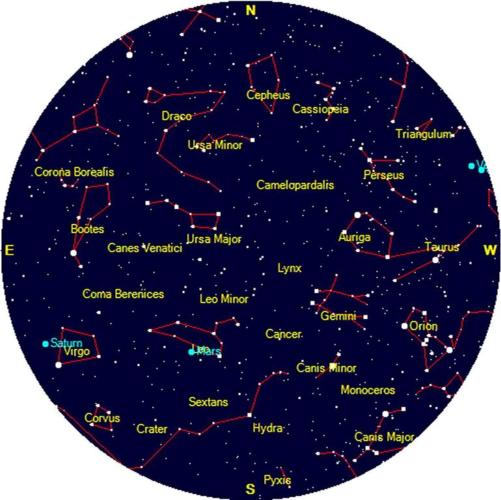
To help you find your way around the night sky please use the following star charts. The first
star chart shows the night sky as it appears about 11pm on 1st, 10pm on 15th and 9pm on
30th.
THE SKY IN MARCH
I have chosen Gemini (the Twins) as this month’s constellation. It is in the south-
southwestern sky about midnight, above and to the left of Orion. Two fairly bright stars at the
top left are named Castor and Pollux and form the heads of the twins. With a bit of
imagination you can see two “stick men” that form the constellation itself as shown in this
diagram:
Just above the left foot of the twin Castor is an open cluster of stars known as M35 which is
visible to the naked eye but better seen with a small telescope or binoculars. This cluster is
made up of several hundred stars and covers an area of sky about the same size as the full
moon (about half a degree).
PLANETS
Mercury on 5th of this month is at its furthest east from the Sun which means it sets quite a
long time (by Mercury’s standards) after sunset making it relatively easy to find but not very
exciting to view as it is small and featureless unless you have use of a large telescope. It just
looks like a very mini-Moon.
Venus has been very conspicuous in the western sky for the last couple of months. Around
11th to 13th it will appear close to another bright planet – Jupiter. Venus is so bright you just
cannot miss it though again, like Mercury, is not an exciting object to view even in a big
telescope as it has a dense atmosphere that hides all surface features.
Mars is much more exciting to observe. It is currently in constellation Leo and will be at
opposition on the 3rd – this is when the Sun, Earth and Mars are all in a line meaning that
Mars is at its closest approach to Earth until the next opposition. Mars is distinctly red in
colour and, through a telescope, surface features such as its northern polar cap and lighter
and darker regions can be seen.
Jupiter, though now becoming dimmer, is still an impressive sight and, as mentioned above,
will appear close to Venus around the middle of the month. Always worth looking at Jupiter
through a telescope of binoculars as its four major moons are easy to spot as are surface
features such as the horizontal bands that run around the planet parallel to its equator. A
good telescope will even allow observers to see the Great Red Spot.
Saturn is approaching opposition so it is also a good subject to view. Even a modest
telescope will let you see its famous rings and its brightest moon, Titan. Saturn can be found
in constellation Virgo.
Uranus is in constellation Pisces and sets not too long after the Sun so you will need to look
for it just after sunset. At the start of the month it will be close to Mercury – the closest
approach being on the 4th. Not an exciting sight but you should see that it has a greenish
tinge.
Neptune is not visible this month.
Of the eight planets the first four as you move out from the Sun (Mercury, Venus, Earth and
Mars) are known as the terrestrial or rocky planets. Then comes the Asteroid Belt made up of
thousands of pieces of rock. Further out are Jupiter and Saturn known as the Gas Giants and
then Uranus and Neptune, the Ice Giants.
Comet C/2009 P1 Garradd will be visible this month though you will need binoculars to spot
it. It can be found between the “saucepan” asterism in Ursa Major and Polaris, the Pole Star.
Between 21st and 26th it will be close to the pan end of the asterism. Try and view it on a
Moonless night as it will be easier to find.
Full Moon is on the 8th and New Moon on 22nd. Sunspots activity is quite good now as we
approach sunspot maximum. If you would like some easy astronomy there is nothing better
than the Sun so long as you never look directly at it especially with binoculars or a telescope
as to do so can cause instant and permanent blindness. However, there is an easy way to
observe the Sun – visit website:
http://spaceweather.com/
You can see sun spots, prominences and other solar features live from the SOHO satellite.
Sunspots appear as dark blobs on the surface of the Sun. The number of spots varies from a
minimum of zero in a month to over two hundred in a regular eleven year cycle. Sunspots are
associated with other solar activity that can have a direct impact on Earth from causing an
increase in Northern Lights to affecting global communication and even electrical power
distribution. For more information on sunspots go to:
http://en.wikipedia.org/wiki/Sunspot
For a nice amateur video of the moon as seen through a medium sized telescope go to:
http://www.youtube.com/watch?v=m_moZHbJWek
These are just a few of the things to see in the sky this month but there are many more. To
see the sky at its best you should allow at least fifteen minutes for your eyes to become dark-
adapted. If you share my interest in astronomy I hope you find these few pointers of help.
Steve Kourik
To help you find your way around the night sky please use the following star charts. The first
star chart shows the night sky as it appears about 11pm on 1st, 10pm on 15th and 9pm on
30th.
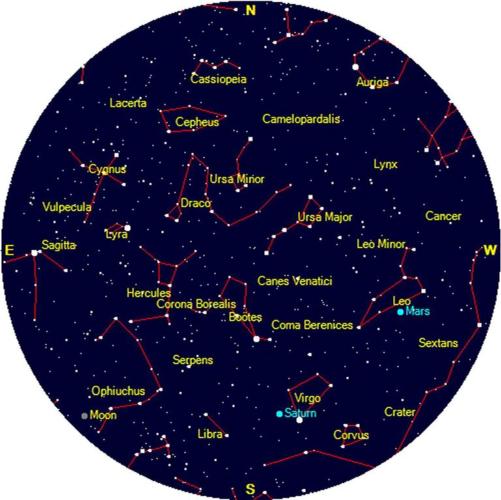
 The second star chart shows the night sky as it appears about 4 am on 1st, 3 am on 15th and 2
am on 30th:
The second star chart shows the night sky as it appears about 4 am on 1st, 3 am on 15th and 2
am on 30th:
 The Sky in March
Motoring Challenge
Diamond Jubilee
Safety in the Home
Olympic Torch
Dorset Countryside News
Benefits Surgeries
Return to top
The Sky in March
Motoring Challenge
Diamond Jubilee
Safety in the Home
Olympic Torch
Dorset Countryside News
Benefits Surgeries
Return to top

 Olympic Sailing