THE BUILDING
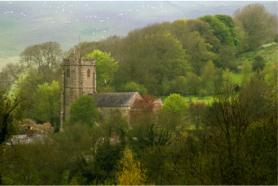
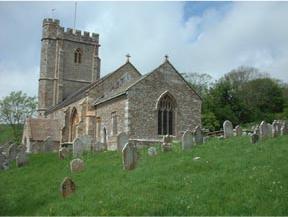
The Parish Church, dedicated to St Mary, is a
fine Grade 1 listed building standing in a
commanding position overlooking the village.
The oldest remaining parts of the church are
sections of the nave, including the south
doorway and the porch which were probably
built early in the 14th century. Late in that
century the chancel was rebuilt. The north and
east walls were rebuilt yet again early in the
19th century. The tower is of late 14th or 15th
century when much of the nave, including the
chancel arch, was built. The church was restored in1878 when the north chapel, now
the vestry, was added.
The organ, bought from Magdalen College Oxford, has
a single manual and was built by Gray and Davidson;
the pedal board is unusual in having the pedals
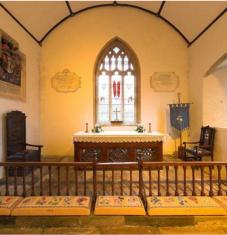
arranged in parallel instead of radially. The altar table,
with a painted wooden frontal, also came from Oxford,
from Balliol. There is a ring of 8 bells, two of them pre-
Reformation, the treble and second dating from 1950,
while the original 6 range in age from 1848 for the 3rd,
4th and 5th to 1656 for the 6th and the late 15th
century for the 7th and tenor; the latter weighs 13.5
cwts.
The clock, blacksmith made in about 1700 or a little
earlier, has neither hands nor a dial and was made to
strike the hours on the hour which it still does by
pulling the necessary number of times on a hammer which strikes the tenor bell. The
clock has a two train movement in a "bird cage" frame which was commonly used from
the last quarter of the 17th century and throughout the 18th. Both trains are powered by
weights giving a little over 24 hours running necessitating winding daily, a task still done
by hand; volunteers are always welcome to join the rota for this purpose. The clock was
neglected from the outbreak of 2nd World War until it was restored in 1982 and
repositioned at the base of the tower where it can readily be seen in action. On display
are plans of the church, churchyard with numbered references to the headstone
inscriptions, together with a list of past Rectors and Vicars dating from 1299 when
Edward I was king.
The sun-dial over the south porch was added
to celebrate the Millennium.
The Parochial Church Council has adopted a
policy whereby the church will embrace
community use and to that end the pews at the
rear of the nave have been removed and the
floor there levelled to provide an open space
for social occasions. As a result of the
generosity of many villagers 50 upholstered
chairs were recently purchased to provide
additional seating when required. A hearing
loop and sound enhancement system have
recently been installed and a professional
recording of our organist Paul Cheater made so that a library of hymns and other music
can be played at St Mary’s, and other churches in the Bride Valley, in the absence of an
organist. To complete the policy the redundant hall is to be demolished, to provide some
car parking space and to create a vehicular access to the churchyard, and the tower is
to be reordered, to provide a WC and small kitchen facility on the ground floor with a
staircase to a new mezzanine floor above. The clock is to be relocated to the
mezzanine floor where it should be visible framed in the west window. These works are
scheduled to start in January 2010.